

For most property owners, a home is the most significant financial investment they will ever make. Protecting that investment means keeping up with routine maintenance, fixing roof leaks, and ensuring structural integrity. However, one of the greatest dangers to a residential property is an enemy that is completely invisible to the naked eye during its initial assault. Termites are often referred to as silent destroyers because they can live and feed inside your home frame for years without showing a single obvious symptom on the surface.
Unlike other common household pests such as ants or rodents, which leave visible trails or actively scavenge in living spaces, termites hollow out wood from the inside out. By the time a casual observer notices major physical damage, such as a buckling floorboard or a crumbling drywall corner, the structural timber framework beneath may already be severely compromised. According to industry statistics, termites cause billions of dollars in property damage across the United States every single year, costs that are almost universally excluded from standard homeowners insurance policies.
To protect your financial equity and avoid catastrophic repair bills, you must become proactive rather than reactive. Recognizing the subtle, early behavioral indicators of these insects before they cause systemic damage is paramount. Here is a comprehensive analysis of the early warning signs of a termite infestation and how to recognize them.
Understanding the Primary Types of Termites
Before examining the warning signs, it is important to understand that not all termites behave the same way. In North America, residential properties are primarily targeted by two distinct categories of these wood-destroying insects: subterranean termites and drywood termites.
Subterranean Termites
Subterranean termites are the most destructive and widespread group in the country. As their name implies, these insects build their primary colonies deep beneath the soil surface. They require constant, high levels of ambient moisture to survive. To access the wood framing of a home, they travel upward from the ground, building specialized protective conduits to shield themselves from open air and low humidity.
Drywood Termites
Drywood termites do not require contact with the soil. Instead, they establish their colonies directly inside sound, dry wood structures, such as attic rafters, hardwood flooring, window frames, and wooden furniture. Because they do not rely on ground moisture, they can thrive in completely elevated locations, making their colonies self-contained and exceptionally difficult to locate.
Early Warning Signs of a Termite Presence
Because termites avoid light and open air, you will rarely see a live worker termite crawling across your floor. Instead, you must train your eye to look for the secondary evidence left behind by their daily feeding and nesting activities.
1. The Sudden Appearance of Mud Tubes
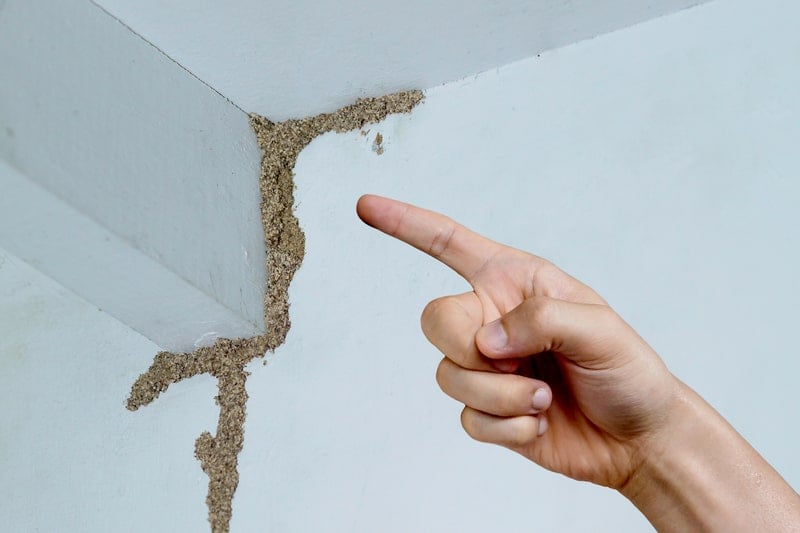
The creation of mud tubes is the most definitive, telltale signature of a subterranean termite presence. These tubes are narrow, pencil-thick conduits constructed from a mixture of soil, debris, and specialized salivary secretions. Termites utilize these structures as covered highways connecting their subterranean nests to the exposed wood of your home.
Look for these mud trails running vertically up concrete foundation blocks, inside crawlspaces, along basement walls, or behind external siding panels. If you find a mud tube and want to test if the infestation is currently active, scrape away a small section in the middle of the tube. If the termites return to rebuild the broken wall within a few days, or if tiny cream-colored insects begin pouring out of the breach, you have an active colony actively feeding on your house.
2. Discarded Insect Wings Left on Windowsills
The reproductive members of a termite colony are known as swarmers or alates. Unlike the blind, pale worker termites, swarmers possess dark bodies and two pairs of long, translucent, equal-length wings. During warm spring or summer days, typically following a heavy rainfall, these winged termites exit their hidden nests in massive clouds to mate and establish new colonies.
Once a swarmer successfully pairs up with a mate, it no longer requires its wings. The insect intentionally sheds them, leaving behind small piles of clear, iridescent wings that look like fish scales. Finding these discarded wings clustered on windowsills, near exterior doorways, or caught in spiderwebs inside your garage is an explicit sign that a mature termite colony is either living inside your structure or very close to the perimeter.
3. Mysterious Accumulations of Frass
While subterranean termites utilize their waste material to build their mud tubes, drywood termites behave differently. To keep their internal wooden galleries clean, drywood termites kick their fecal matter out through microscopic exit holes in the wood surface.
This accumulated waste is known as frass. Termite frass takes the form of tiny, hard, elongated pellets that look remarkably like mounds of ground black pepper, sawdust, or sand. If you notice tiny, localized piles of these geometric pellets appearing consistently on window ledges, beneath wooden cabinets, or on the floor beneath an attic hatch, you are looking at the direct waste output of a drywood termite gallery located directly above.
4. Changing Surface Dynamics: Blistering and Hollow Sounding Wood
As termites feed, they eat along the grain of the wood, consuming the soft interior cellulose while leaving the hard exterior veneer or paint layer completely intact. This creates an structural empty shell.
-
The Hollow Tap Test: Walk through your home and tap a screwdriver handle along baseboards, door casings, and exposed structural beams. A solid piece of wood will produce a sharp, solid thud. If a section produces a dull, hollow, or papery echo, it indicates internal tunneling.
-
Blistering Surfaces: When termites tunnel exceptionally close to the surface of painted wood or drywall, the internal moisture they bring into the gallery can cause the exterior paint layer to bubble, blister, or crack, mimicking the appearance of simple water damage.
5. Sticking Windows and Warping Doors
As termites tunnel through door frames and window casings, they introduce moisture into the wood fibers to regulate their nesting environment. This localized humidity causes the surrounding wood to swell and expand.
If you notice that a previously smooth door suddenly starts sticking in its frame, or if a window becomes exceptionally difficult to slide open or close over the span of a few weeks, do not simply blame the seasonal weather shifts. This structural resistance is often a sign that termites have altered the framework geometry from the inside out.
Differentiating Termites from Winged Ants
Homeowners frequently misidentify termite swarmers as harmless flying ants, leading to a dangerous delay in professional treatment. While they look similar at a casual glance, they possess completely distinct anatomical profiles:
-
The Waist Structure: Ants possess a highly defined, narrow, pinched waist separating their thorax and abdomen. Termites have a thick, straight, uniform body waist with no obvious segmentation.
-
The Antennae Shape: Ant antennae are bent at a sharp, 90-degree elbow angle. Termite antennae are perfectly straight and resemble a tiny string of small round beads.
-
The Wings: Both insects have four wings, but an ant’s front wings are significantly larger and longer than its hind wings. A termite’s wings are all four identical in size, shape, and length, extending far past the end of its abdomen.
Proactive Perimeter Prevention Strategies
Preventing termites from targeting your property requires eliminating the specific environmental conditions that make your home attractive to them.
-
Eliminate Soil-to-Wood Contact: Never allow the wooden elements of your home, such as siding, door frames, or support posts, to come into direct physical contact with the bare earth. Ensure there is a minimum gap of six inches of concrete foundation visible between the ground and your lower wood frame.
-
Manage Exterior Mulch Usage: Mulch is made of shredded wood, which is prime termite food. Furthermore, thick layers of mulch retain immense moisture against your home’s perimeter. Keep landscape mulch beds kept back at least two feet from your foundation wall, or utilize non-organic alternatives like crushed stone or river rock near the house framing.
-
Redirect Moisture Runs: Ensure your gutter downspout extensions discharge rainwater at least three to five feet away from the foundation block. Fix exterior air conditioning condensate drips and leaky outdoor spigots immediately, as puddles against the foundation invite subterranean scouts straight to your perimeter walls.
Frequently Asked Questions
Do termites create visible piles of sawdust when they drill into wood?
No, termites do not leave piles of clean sawdust behind. Termites consume the wood cellulose as a primary food source, meaning the wood passes through their digestive tracts. If you see active piles of fresh, shredded sawdust beneath a wooden structure, you are likely dealing with carpenter ants or powderpost beetles, which excavate wood solely to build nesting tunnels rather than eating the material.
Can a homeowner eliminate a mature termite infestation using do-it-yourself chemical sprays?
While do-it-yourself topical pesticide sprays can instantly kill individual worker termites on contact, they are entirely ineffective at eradicating an entrenched infestation. Termite colonies contain hundreds of thousands of individuals hidden deep beneath the soil or deep inside solid timber. Commercial topical sprays fail to reach the core queen, who can produce thousands of eggs daily. Complete eradication requires professional liquid soil barriers, specialized localized wood injections, or commercial baiting systems.
How quickly can a colony of termites cause severe structural damage to a house?
Termites are relatively slow, methodical eaters. A standard colony of approximately 60,000 subterranean workers consumes roughly one-fifth of an ounce of wood per day. At this rate, it would take several years of uninterrupted feeding to cause the total collapse of a residential home. However, the true danger lies in the fact that infestations routinely go completely unnoticed for five to ten years, allowing that daily damage to accumulate into catastrophic structural failures over time.
Are brick-front or concrete slab homes immune to termite damage?
No, brick and concrete slab homes are not safe from termites. Termites do not eat concrete or brick, but they can utilize microscopic settling cracks as narrow as one-thirty-second of an inch within a concrete slab to travel upward into a home. Once inside, they will quickly bypass the masonry exterior to feed on the internal wooden wall studs, drywall paper, hardwood flooring, and ceiling joists.
What is a termite bond and should I purchase one for my home?
A termite bond is a formal service contract between a homeowner and a licensed pest control company. It typically includes an initial comprehensive treatment, annual or bi-annual proactive inspections, and a structural warranty. Under the terms of a comprehensive bond, if termites return and cause new damage while the contract is active, the pest control company is legally obligated to treat the home and pay for the structural repairs at no additional cost to the homeowner.
Will cold winter weather kill off an active termite colony?
No, winter freezing temperatures will not eradicate termites. When the top layer of soil freezes in northern climates, subterranean termites simply retreat deeper down into the earth below the frost line, where temperatures remain stable and manageable. If a colony has already successfully established itself inside the warm, climate-controlled walls or basement of your home, they will continue to feed and tunnel actively 365 days a year without pausing for winter.